Kilo to Lbs: The Easy Conversion Guide With Table
To work out kilo to lbs, multiply the kilos by 2.20462. A kilo is short for a kilogram, so 1 kilo equals 2.20462 lbs, 24 kilos is 52.91 lbs and 100 kilos is 220.46 lbs. This guide gives you the exact formula, a step-by-step worked example, a reference table and the everyday figures people look up most, so the next time a scale, a recipe or a shipping label asks for kilo to lbs, you will have the answer in seconds.
How to Convert Kilo to Lbs: The Formula
The formula for kilo to lbs is lbs = kilos x 2.20462. That factor never changes, because a pound is defined as 0.45359237 kilograms. Kilo is just short for kilogram, so this conversion is identical to converting kilograms to pounds, and every figure in this guide matches the Kg to Lb guide. Rounding the factor to 2.2 is fine when you only need an estimate, but for parcels, luggage limits and official documents, use the full 2.20462 and round the answer at the end.
Here is the conversion worked through step by step with 24 kilos, the weight of a medium dog or a large suitcase:
- Step 1: Take the weight in kilos: 24 kilos.
- Step 2: Multiply by 2.20462: 24 x 2.20462 = 52.91088.
- Step 3: Round to two decimal places: 52.91 lbs.
So 24 kilo to lbs is 52.91 lbs. The reverse is just as simple: kilos = lbs x 0.453592. For example, 44 lbs x 0.453592 = 19.95805, which rounds to 19.96 kilos. The Kg in Lbs guide shows more reverse conversions, and the Kg to Stones Converter gives you both directions, plus stones, in one place.
Kilo to Lbs Conversion Table
Use this table whenever you want a fast kilo to lbs answer without doing the multiplication yourself. Every value is worked out with the exact factor 2.20462 and rounded to two decimal places.
| Kilos | Pounds (lbs) |
|---|---|
| 1 kilo | 2.20 lbs |
| 3 kilos | 6.61 lbs |
| 5 kilos | 11.02 lbs |
| 8 kilos | 17.64 lbs |
| 12 kilos | 26.46 lbs |
| 24 kilos | 52.91 lbs |
| 33 kilos | 72.75 lbs |
| 44 kilos | 97.00 lbs |
| 55 kilos | 121.25 lbs |
| 66 kilos | 145.50 lbs |
| 77 kilos | 169.76 lbs |
| 99 kilos | 218.26 lbs |
Common Kilo to Lbs Values People Look Up Most
Most kilo to lbs searches are about body weight, and the numbers cluster in a narrow band. A person who weighs 50 kilos is 110.23 lbs, 60 kilos is 132.28 lbs, 65 kilos is 143.30 lbs, 70 kilos is 154.32 lbs, 75 kilos is 165.35 lbs, 80 kilos is 176.37 lbs, 85 kilos is 187.39 lbs and 90 kilos is 198.42 lbs. Notice how the pound figure grows faster than the kilo figure: every extra kilo adds 2.20462 lbs, so a 5 kilo gain on the scales shows up as about 11 lbs, which often surprises people who switch a bathroom scale from kilos to pounds for the first time.
Away from body weight, the values people check most are luggage and parcels. A standard checked bag of 23 kilos is 50.71 lbs, just above the 50 lbs limit many airlines set, which is exactly why that limit catches travellers out. A 20 kilo bag is 44.09 lbs, a 30 kilo bag is 66.14 lbs and a 32 kilo bag is 70.55 lbs. For post, a 1 kilo parcel is 2.20 lbs, a 2 kilo parcel is 4.41 lbs and a 5 kilo parcel is 11.02 lbs, so a kitchen scale reading in kilos translates directly into the pounds a courier or a recipe might ask for.
Practical Examples of Kilo to Lbs
A newborn baby. A baby born at 3.6 kilos weighs 3.6 x 2.20462 = 7.93663 lbs, which rounds to 7.94 lbs, or 7 lb 15 oz. A 4 kilo baby is 8.82 lbs. These small numbers show why rounding matters: using 2.2 instead of 2.20462 would give 7.92 lbs, close, but not the figure a health visitor would record.
A gym plate. A 33 kilo plate is 72.75 lbs, a 12 kilo plate is 26.46 lbs and a 24 kilo plate is 52.91 lbs. If a workout plan calls for a 70 lb dumbbell, that is 31.75 kilos, so a 33 kilo dumbbell is a little heavier than the plan asks for, while a 30 kilo dumbbell, at 66.14 lbs, is a little lighter.
A suitcase. Packing for a flight with a 23 kilo allowance means 50.71 lbs, so if your airline also quotes a 50 lbs limit, the kilo allowance is the stricter one by 0.71 lbs. Weigh your bag at home in kilos, multiply by 2.20462, and leave a little margin: a bag that reads 22.5 kilos is 49.60 lbs, safely inside, while 23 kilos is 50.71 lbs, over the line.
A recipe. A recipe calling for 1.5 kilos of flour needs 3.31 lbs, and 500 g, which is 0.5 kilo, needs 1.10 lbs. Converting the whole recipe at once is easier than converting each ingredient, and the Kg to Stones Chart can double as a kitchen reference when a recipe switches between metric and imperial.
Kilo to Lbs and Stones: How the Units Connect
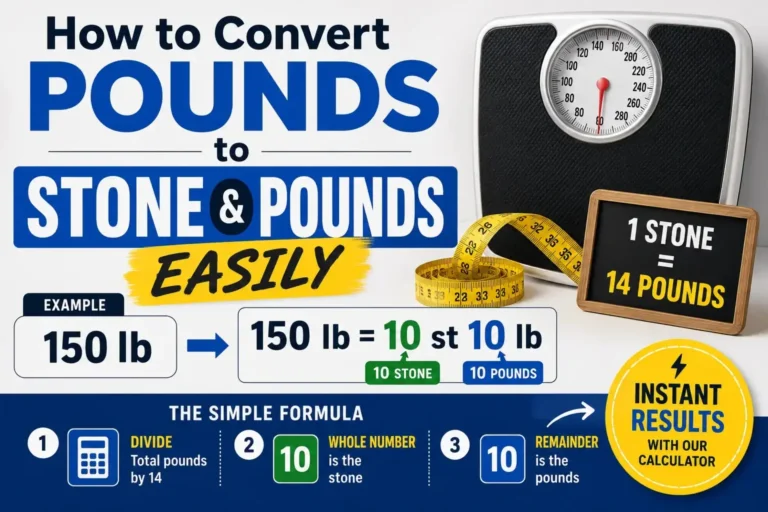
In the UK, body weight is often given in stones, so it helps to know how kilo to lbs connects to stones. One stone is 14 lbs, and one stone is 6.35029 kilos. That means 1 kilo is 0.157473 stones, so 66 kilos is 10.39 stones, written as 10 st 5.5 lbs, because 66 kilos is 145.50 lbs, and 145.50 lbs divided by 14 is 10.39 stones. Likewise, 100 kilos is 220.46 lbs, which is 15.75 stones, or 15 st 10.5 lbs. If you think in stones, the path is kilos to pounds first, then divide the pounds by 14 and keep the remainder as pounds, which is exactly how the converter on the home page works.
Common Mistakes to Avoid When Converting Kilo to Lbs
Kilo to lbs conversions are simple, but five mistakes appear again and again, and each one changes the answer enough to matter.
- Using 2.2 for exact work. Multiplying by 2.2 instead of 2.20462 is fine for a rough guess, but on 100 kilos it gives 220 lbs instead of 220.46 lbs, an error of nearly half a pound.
- Rounding too early. Rounding the factor to 2.20 before you multiply, then rounding the answer again, stacks two small errors. Always multiply with 2.20462 and round once, at the end.
- Mixing up the direction. Multiplying pounds by 2.20462 instead of dividing gives a wildly wrong answer: 100 lbs is 45.36 kilos, not 220.46 kilos.
- Reading stones as pounds. A weight of 11 stone is 154.32 lbs, not 11 lbs, so never put a stones figure straight into a pounds column.
- Trusting the wrong scale setting. A scale set to stones will display a smaller number than the same weight in kilos, so check the unit on the display before you write the number down.
Related Conversions
If this guide answered your kilo to lbs question, the next conversion is usually close behind. The Kg vs Lbs Comparison explains how the two units differ, the Kilo to Lb guide gives quick answers for the most common single values, the Kg to Stones Chart lists whole-kilo values in stones and pounds, and the Kg to Stones Converter handles any weight you type in, giving stones, pounds and kilograms together.
Frequently Asked Questions
How many lbs is 1 kilo?
1 kilo is 2.20462 lbs, which rounds to 2.20 lbs. That single factor is the whole conversion: multiply any number of kilos by 2.20462 to get pounds.
What is 24 kilos to lbs?
24 kilos to lbs is 52.91 lbs. The working is 24 x 2.20462 = 52.91088, rounded to two decimal places.
What is 66 kilos to lbs?
66 kilos to lbs is 145.50 lbs. The working is 66 x 2.20462 = 145.50492, rounded to two decimal places. In stones, that is 10 st 5.5 lbs.
How do I convert kilo to lbs without a calculator?
Double the kilos and add ten percent of the result: for 24 kilos, double it to 48, add 4.8, and you get 52.8 lbs, against the exact 52.91 lbs. That shortcut works because 2.2 is close to 2.20462, and it is accurate to within a few tenths of a pound for everyday weights.
Is 1 kilo heavier than 1 lb?
Yes. One kilo is 2.20462 lbs, so a kilo is more than twice as heavy as a pound, and a number in kilos is always smaller than the same weight expressed in pounds.
How many kilos is 99 lbs?
99 lbs is 44.91 kilos. Multiply the pounds by 0.453592: 99 x 0.453592 = 44.90561, which rounds to 44.91 kilos.
What is the formula for kilo to lbs?
The formula is lbs = kilos x 2.20462. To reverse it, use kilos = lbs x 0.453592, or divide the pounds by 2.20462.