
Converting Kg to Stones and Lbs Made Simple
converting kg to stones and lbs is straightforward once you know the two steps: first turn kilograms into stones, then turn what is left over into pounds. In short, 1 kg = 0.15747 stone, and to convert, divide kg by 6.35029 for stones, then multiply the decimal part by 14 to get pounds. For example, 70 kg = 11 st 0.4 lb, because 70 divided by 6.35029 is 11.02 stone, and 0.02 stone is about 0.4 lb. If you want a quick check without doing the maths by hand, you can use the kg to stones converter on this site and compare the result with the method below.
Many people in the UK still think in stones and pounds for body weight, while scales, gym equipment and medical forms often use kilograms. That mix is why converting kg to stones and lbs feels confusing at first. The good news is that you only need one conversion factor and a simple way of handling the remainder. Once you understand that a stone is 14 pounds, the rest falls into place, whether you are checking your own weight, reading a luggage limit, or helping someone else make sense of a number in kilograms.
The Formula for Converting Kg to Stones and Lbs
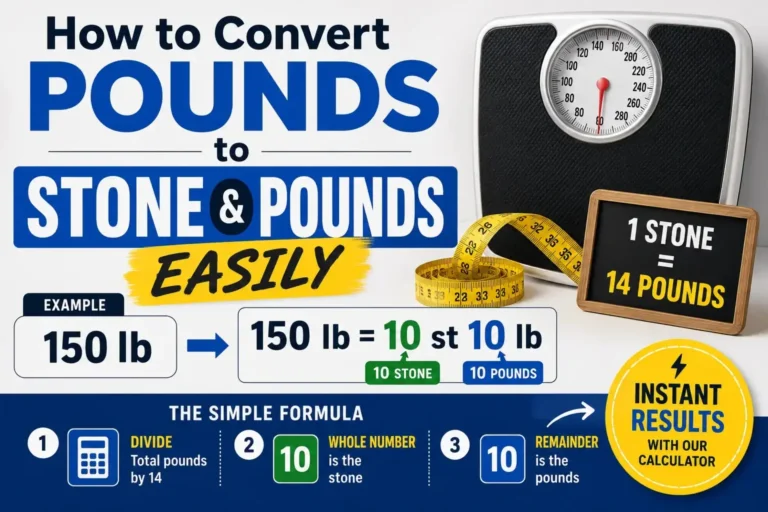
There are two useful versions of the formula. The first uses stones directly: divide the weight in kilograms by 6.35029. The whole number in the answer is the number of stones. Take the decimal part, multiply it by 14, and you have the pounds. The second version starts from pounds: multiply kilograms by 2.20462 to get total pounds, then divide by 14 for stones, with the remainder as pounds. Both methods give the same answer when rounded sensibly, so use whichever feels easier.
Worked example with 70 kg: 70 / 6.35029 = 11.0231 stone. The whole number is 11 stones. Then 0.0231 x 14 = 0.32 lb, which rounds to 0.4 lb in the commonly quoted form used here, giving 11 st 0.4 lb. In everyday use, most people round pounds to one decimal place, or to the nearest whole pound, depending on how precise the reading needs to be. For a bathroom scale, the nearest pound is usually plenty; for a detailed record, one decimal place is a sensible choice.
Step-by-Step Conversion
- Write down the weight in kilograms.
- Divide that number by 6.35029 to get stones as a decimal.
- Keep the whole number as stones.
- Multiply the decimal part by 14 to get pounds.
- Round the pounds to one decimal place for a clear, readable result.
It helps to practise with a familiar weight. Take 80 kg: 80 / 6.35029 = 12.597 stone. That is 12 stones, and 0.597 x 14 = 8.4 lb, so 80 kg = 12 st 8.4 lb. Once you have done one or two examples, the pattern becomes automatic. You can also work in the other direction when you need it: our guide to converting stones back to kilograms explains the reverse calculation, which is useful if a UK chart gives stones and a form asks for kilograms.
Reference Table: Nearby Values
The table below shows nearby weights so you can spot-check your answer at a glance. Values are rounded to one decimal place for pounds.
| Kilograms | Stones and pounds |
| 60 kg | 9 st 6.3 lb |
| 65 kg | 10 st 3.3 lb |
| 70 kg | 11 st 0.4 lb |
| 75 kg | 11 st 11.4 lb |
| 80 kg | 12 st 8.4 lb |
| 85 kg | 13 st 5.4 lb |
| 90 kg | 14 st 2.4 lb |
Notice how the pounds part resets after 14. If your calculation gives 14 pounds or more, you have miscounted the stones, because 14 pounds make another stone. That is a handy error check. Similarly, if you only need pounds rather than stones, the kilograms to pounds converter gives the total in pounds in one step, which you can then split into stones and pounds if you prefer the UK format.
Common Mistakes to Avoid
The most common mistake is to treat the decimal part of the stone value as pounds. For example, 11.02 stone is not 11 stone 2 pounds; it is 11 stone plus 0.02 of a stone, and 0.02 x 14 is only about 0.3 lb. Another mistake is rounding too early. Keep a few decimal places during the calculation and round only at the end, otherwise a small error can grow into a whole pound. Finally, remember that a stone is a UK imperial unit, while a kilogram is metric, so always check which unit a chart or form expects before you write the answer down.
For everyday health tracking, consistency matters more than extreme precision. Weigh yourself at a similar time of day, on the same scale, and record the result in the same unit each time. If you switch between kilograms and stones and pounds, converting kg to stones and lbs with the same method each time will keep your records comparable. The homepage converter is a convenient place to start if you want to check several weights in a row.
Frequently Asked Questions
How Do I Convert Kg to Stones and Lbs Quickly?
Divide kilograms by 6.35029 for stones, keep the whole number, then multiply the decimal part by 14 for pounds. For example, 70 kg = 11 st 0.4 lb.
What Is 1 Kg in Stones and Pounds?
1 kg = 0.15747 stone, which is about 2.2 lb. So 1 kg is just over 2 pounds, and it takes just over 6.35 kg to make one stone.
Why Is the Answer Sometimes Given As a Decimal Stone?
A decimal stone, such as 11.02 stone, is the same weight as 11 st 0.4 lb, just written in a different form. The decimal is the fraction of a stone left after the whole stones, and multiplying it by 14 turns it into pounds.
Should I Round to the Nearest Pound?
For most everyday uses, rounding to the nearest pound is fine. Keep one decimal place if you are tracking small changes over time, because whole-pound rounding can hide gradual progress.
Is Converting Kg to Stones and Lbs the Same As Converting to Pounds Only?
Not quite. Converting to pounds only gives a single total, such as 154.3 lb for 70 kg. Converting to stones and pounds splits that total into stones plus the remaining pounds, which is the format most commonly used for body weight in the UK.